
The name “emerald” originates from the Old French word *esmeralde*, meaning “green stone.”
Emeralds are mined globally, with Colombia renowned for producing the world’s finest deep‑green emeralds—supplying roughly 50–95% of global demand each year. Zimbabwe also holds one of the world’s largest deposits.
Emeralds are softer than sapphires and belong to the beryl family.
Emerald is the traditional birthstone for May.
Emerald Grading
Emeralds are graded using the same four key parameters as other gemstones—Color, Clarity, Cut, and Carat Weight (the 4Cs).
There is no single globally recognised grading authority for emeralds. Different traders and institutions use varying systems. Within the trade, an AAA‑style scale (similar to pearls) is commonly used alongside 4Cs evaluation.
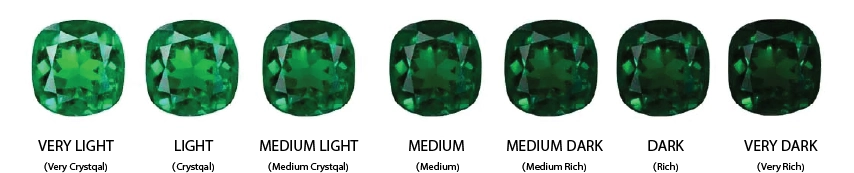
COLOR
Emeralds range from bright to deep green, including bluish and yellowish hues. Color preference varies greatly with individual taste.
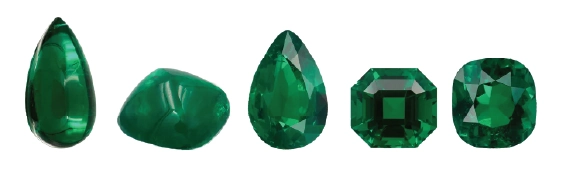
CUT
Due to emeralds being softer and commonly fractured, they are often cut into rectangles, triangles, or rounds to protect corners and maximise hue, tone, and saturation.
CARAT WEIGHT
As with all gemstones, value generally increases with size. Common jewellery sizes typically range from 0.50–1.00 carat.
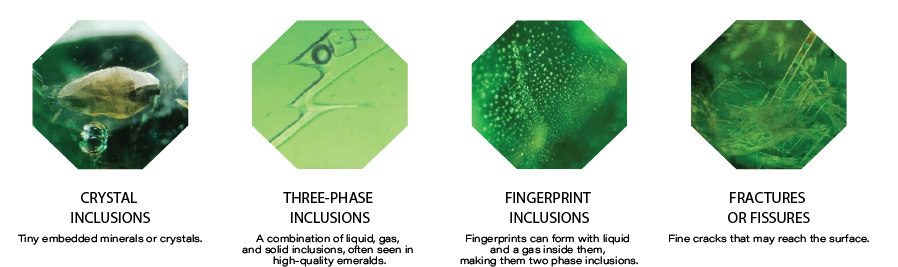
CLARITY
Nearly all emeralds contain inclusions. Clarity is considered primarily when inclusions significantly impact transparency. Flawless emeralds are virtually non‑existent.
At Harmony
We work with responsible sorters to source only high‑quality emeralds. We can arrange GIA examination and certification upon request.
RUBY
Ruby is one of the four precious gemstones, alongside emerald, sapphire, and diamond.
Its name comes from the Latin *rubens*, meaning “red.”
Ruby ranks 9 on the Mohs Scale of Hardness—extremely durable and second only to diamond, equal to sapphire.
The most sought‑after shade is a deep red with a hint of blue, known as “pigeon’s blood.”
Almost all rubies contain natural inclusions. Flawless rubies are exceptionally rare and often exceed diamond prices of similar size and quality.
Rubies are mined in Myanmar (Burma), Africa, Australia, the USA, and other regions. Myanmar is especially famed for high‑quality deposits.

Ruby Buying Tips
Ruby can appear similar to garnet or spinel to the untrained eye. At Harmony, we supply only genuine ruby.
Most natural rubies undergo heat treatment to enhance color—this is standard worldwide and accepted by international regulatory bodies.
We provide full product descriptions and can arrange GIA examination and certification upon request.
SAPPHIRE
Sapphire is a member of the corundum mineral family; any corundum that is not red (ruby) is classified as sapphire.
Fancy sapphires include yellow, pink, white, green, purple, orange, and black varieties.
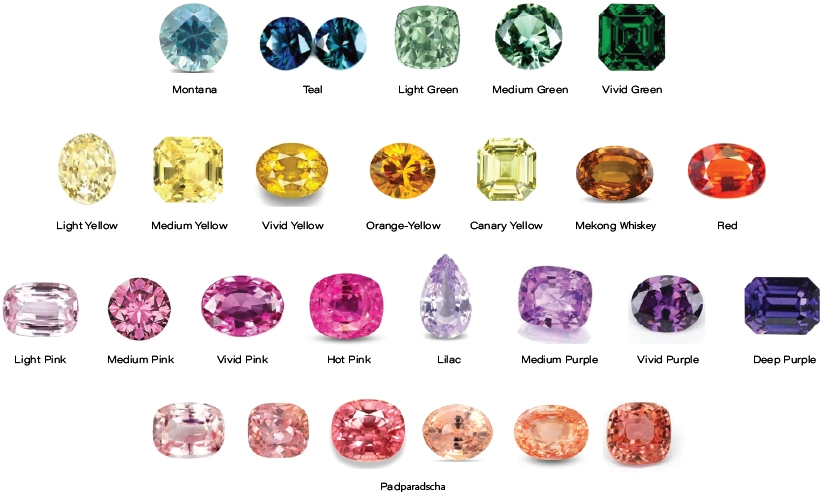
Blue sapphires are the most valuable and widely desired, especially those with vivid royal‑blue color.

Sapphires are mined worldwide, with Myanmar being one of the largest and most significant sources.
Most natural sapphires are heat‑treated to improve color and clarity—an accepted, permanent enhancement across the industry.
Sapphire Buying Tips
At Harmony, we source sapphires of exceptional quality and can arrange GIA examination and certification upon request.